Climate Note · Jul 30, 2026
Updated U.S. Climate Opinion Factsheets for 2025
By Jennifer Marlon, Emily Goddard, Martial Jefferson, Emily Richards and Anthony Leiserowitz
Filed under: Beliefs & Attitudes, Policy & Politics, Audiences and Climate Impacts
We are pleased to announce the updated U.S. Climate Opinion Factsheets tool.
This tool makes it easy to create and share customized factsheets about climate change opinions in your community. Each factsheet can include up to 34 key measures of public knowledge, attitudes, policy support, and behavior for each individual state and the District of Columbia, congressional district, and county in the U.S.
What’s new:
- Four new measures: Explore whether people support building solar farms or wind farms in their local area, prefer candidates who support action on global warming, and oppose drilling and mining for fossil fuels on public lands.
- Updated estimates: The factsheets now incorporate survey data collected through 2025.
- Current district boundaries: Congressional district estimates reflect the boundaries of the 119th Congress (2025-2027).
To create a factsheet, select a geographic area and the measures that interest you. Factsheets are available in English and Spanish and can be downloaded as PDFs, printed, or shared through a direct URL.
These resources can support conversations with elected officials, journalists, community members, business leaders, and students. For example, you can create a standardized factsheet for Milwaukee County, Wisconsin, or generate a customized version focused on the opinions most relevant for your work.
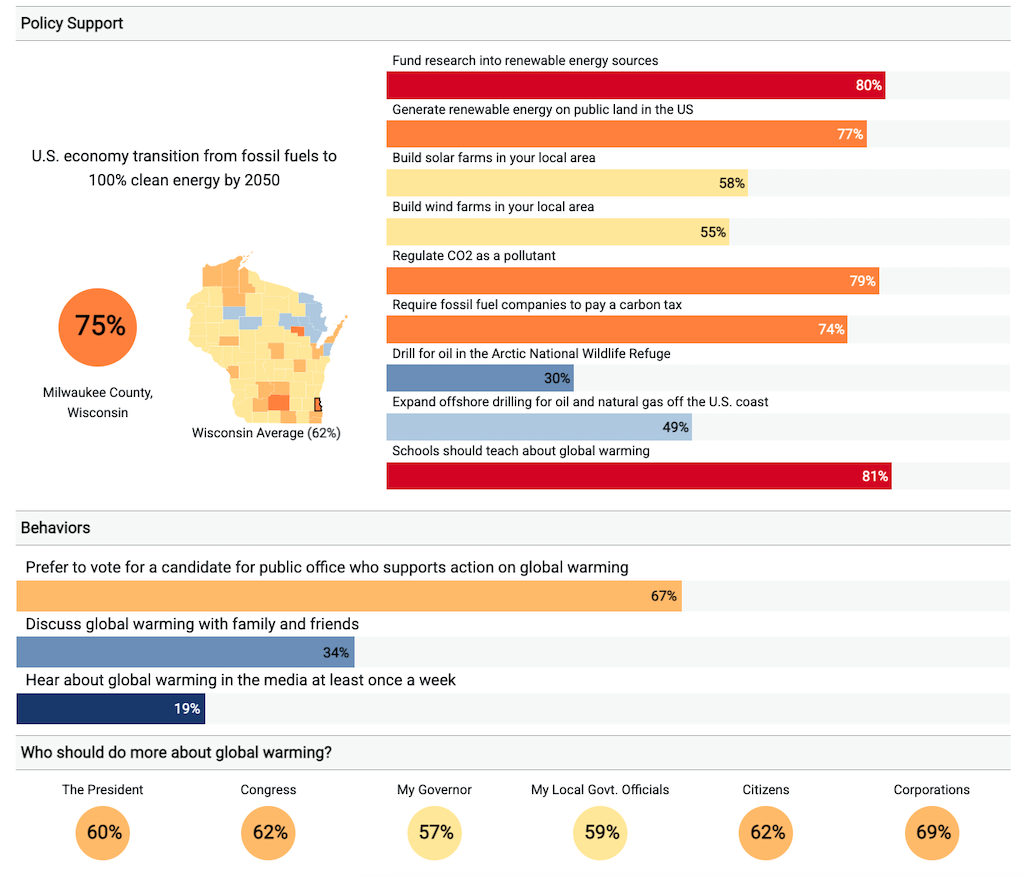
Explore the U.S. Climate Opinion Factsheets.
For more details and answers to frequently asked questions about the underlying methodology, visit the Yale Climate Opinion Maps.