Oct 1, 2026
Discover unique insights with the updated CCAM Explorer for 2026
By Emily Goddard, Jennifer Marlon, Matthew Ballew, Jennifer Carman, John Kotcher, Edward Maibach, Seth Rosenthal and Anthony Leiserowitz
Filed under: Audiences, Behaviors & Actions, Messaging, Beliefs & Attitudes and Policy & Politics
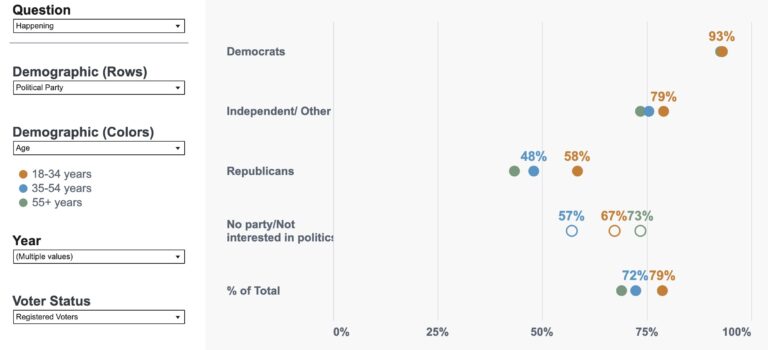
We are pleased to announce the latest version of the Climate Change in the American Mind (CCAM) interactive dashboard and data visualizer – the CCAM Explorer. The tool and dataset, which include data going back to 2008, is updated to include data from 2025, letting you investigate changes in Americans’ opinions about climate change over time and across different demographic and political groups. You can also download the underlying dataset, which includes 33 waves of data from the Climate Change in the American Mind study, from the Open Science Framework.
Exploring and Visualizing Climate Opinion Data
The CCAM Explorer allows users to investigate otherwise unreported results from the Climate Change in the American Mind surveys, find their own insights, and create their own visualizations. Pulling from 33 waves of climate change public opinion data, the CCAM Explorer allows users to analyze the responses to 21 questions by year, demographics, and political ideology. By navigating the three tabs at the top of the tool — Climate Views by Demographics, Climate Views Over Time, and Politics and Climate Views — and using the dropdown menus (e.g., Question, Demographic, Year, and Voter Status), users can customize the data displayed, generate hundreds of different results, and investigate insights specific to their interests and needs.
Are you curious about trends in support for renewable energy among conservative Republicans? Who do you think is more worried about climate change in the Northeast – women or men? Do younger people hear about global warming in the media more or less than older people? How do these findings differ by race and education? These are just a few of the many questions users can ask and answer in the CCAM Explorer. Below, we highlight some insights that we think you’ll find interesting, but we encourage you to go to the tool and explore the data for yourself!
Climate Beliefs by Gender and Political Ideology
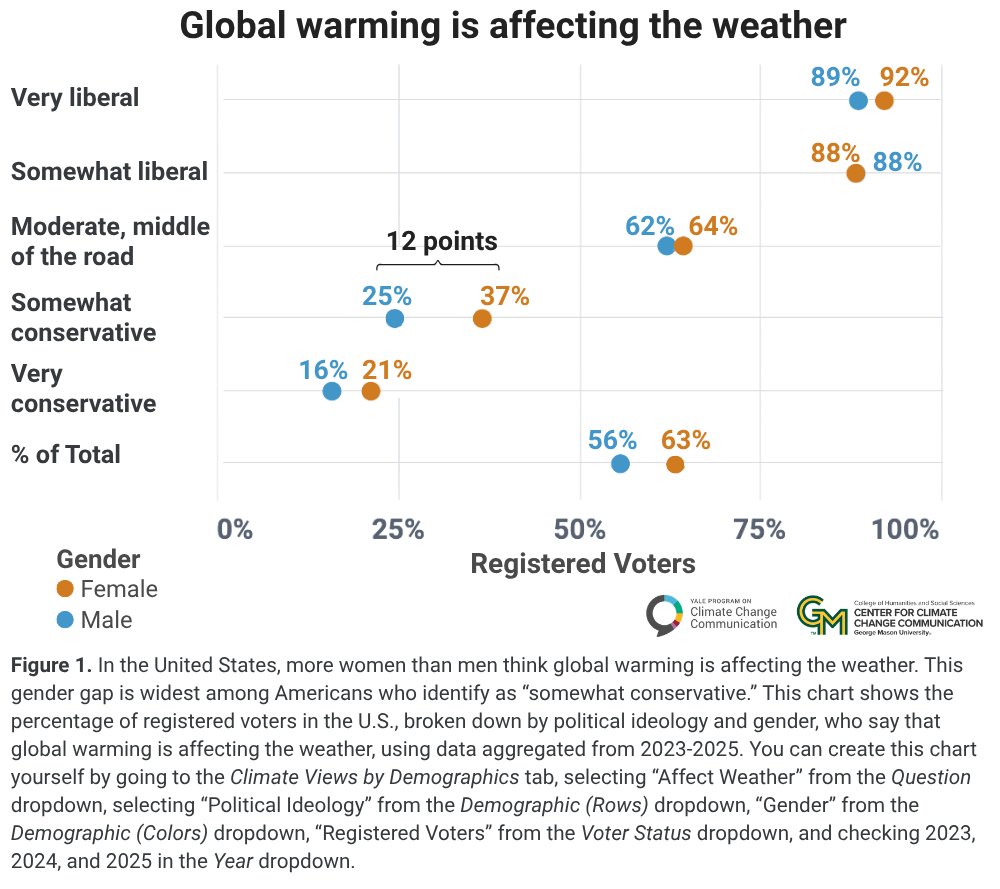
Overall, among U.S. registered voters, more women than men believe climate change is happening (75% vs. 70%), human-caused (63% vs. 56%), and affecting the weather (63% vs. 56%). However, this gender belief gap varies widely based on political ideology. Across all ideological groups, the gender gap is widest among those who identify as “somewhat conservative,” where more “somewhat conservative” women than men think that global warming is happening (56% vs. 46%), human-caused (41% vs. 27%), and affecting the weather (37% vs. 25%).
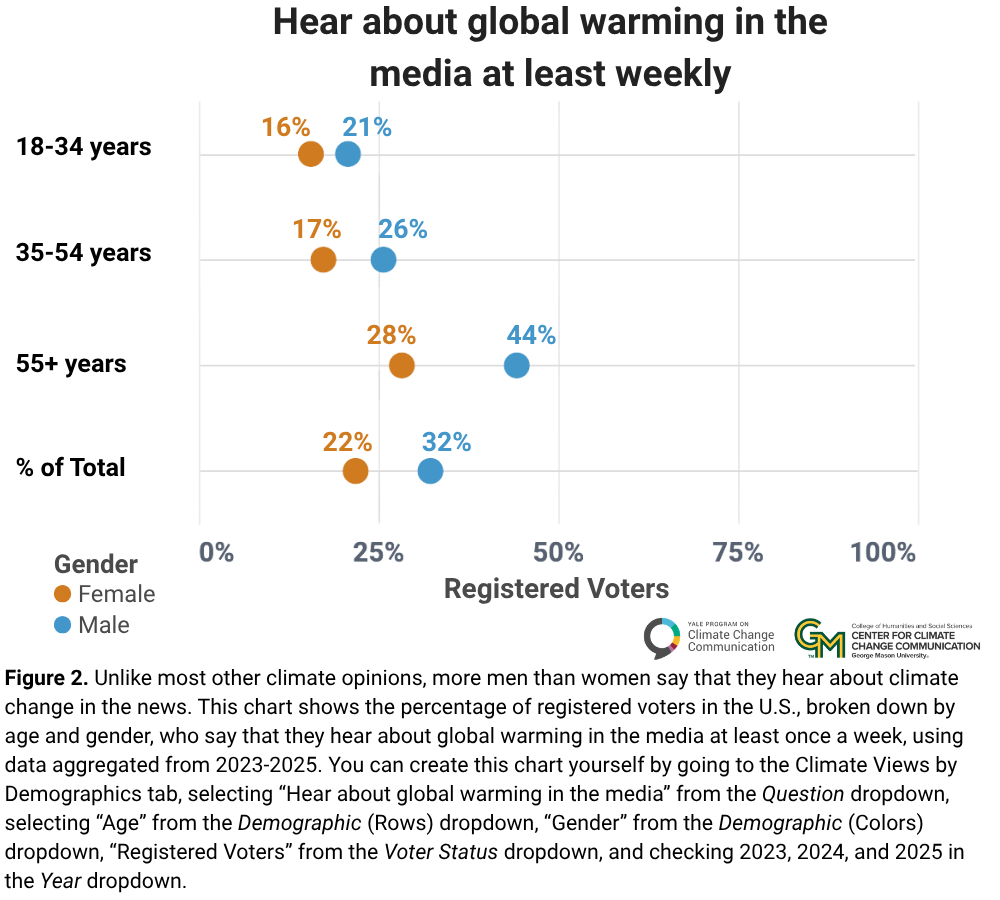
Regardless of political ideology, women report more pro-climate views across almost all climate beliefs, risk perceptions, and support for policies. However, more men than women say that they hear about climate change in the news (32% of men vs. 22% of women), with older men (44%) saying they hear about climate change in the news more often than younger men (21%).
Climate Risk Perceptions by Education and Political Ideology
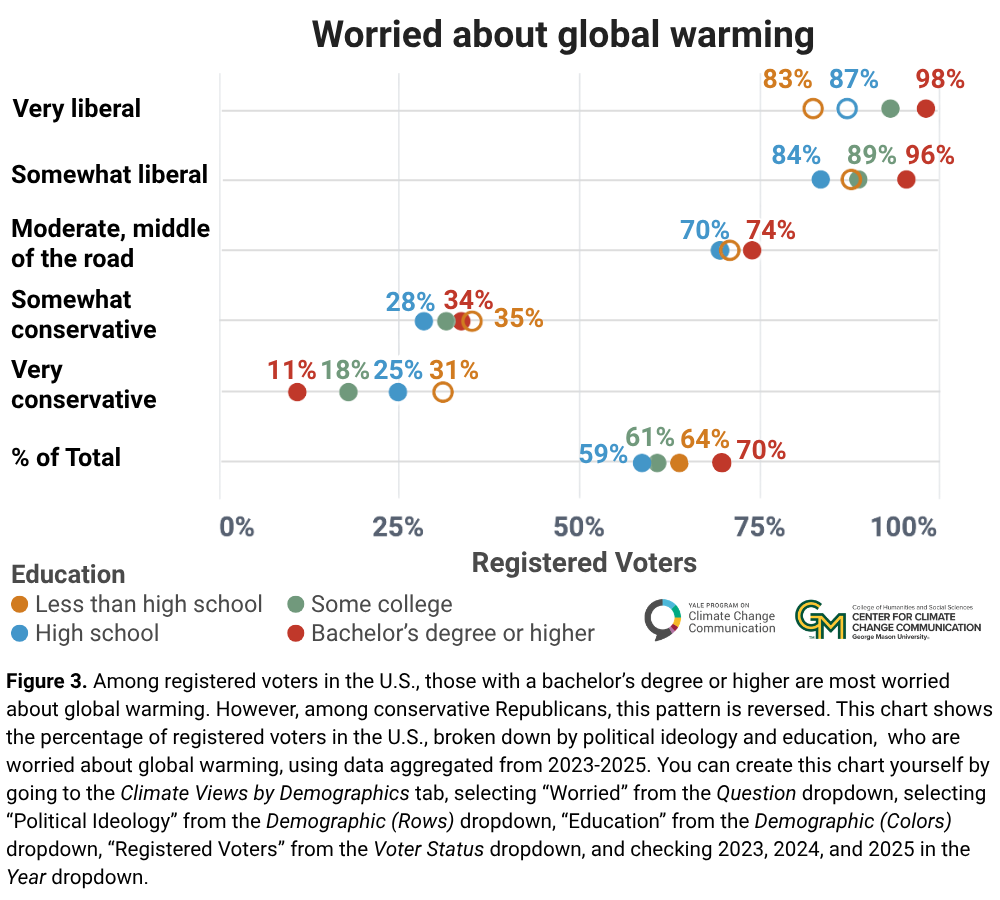
As with gender, climate beliefs also vary across education levels. Among registered voters in the U.S., those with a bachelor’s degree or higher are more worried about global warming (70%) than are those with some college but no degree (61%), a high school degree (59%), or less than a high school degree (64%). Those with a bachelor’s degree or higher are also more likely to think global warming is harming U.S now (64%) and will do so in the future (69%) than are those with some college but no degree (55% and 60%), a high school degree (53% and 56%,), or less than a high school degree (55% and 62%).
However, this pattern is reversed among conservatives – worry about global warming is highest among those with less than a high school degree (31% among the “very conservative” and 35% among the “somewhat conservative”), as is the belief that global warming is harming the U.S. now (26% among the “very conservative” and 41% among the “somewhat conservative”). In contrast, those who are “very conservative” and have a bachelor’s degree or higher are less worried about global warming (11%) and less likely to think it is harming the U.S now (10%) or will do so in the future (14%) than the “very conservative” with less education.
Climate Change in the Media
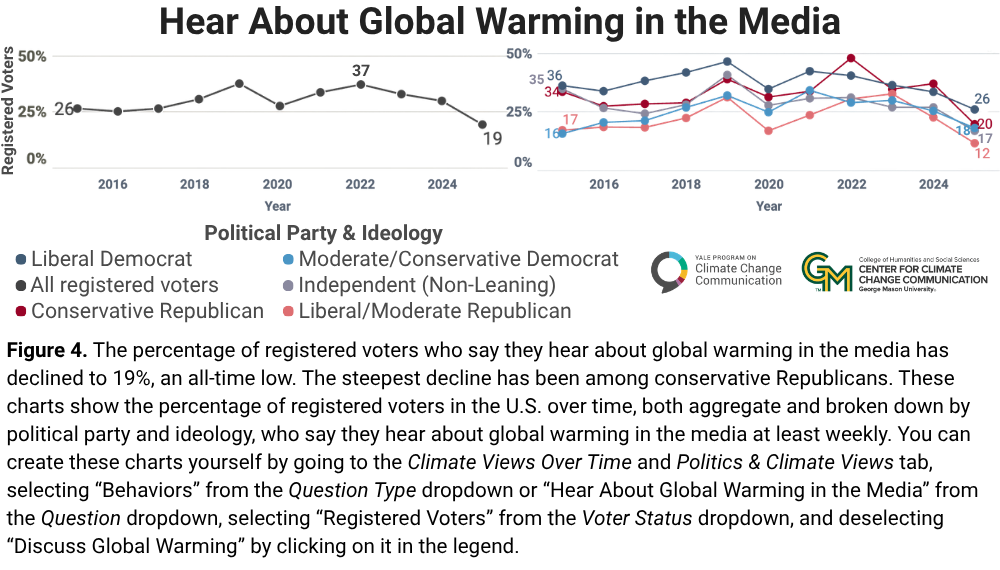
The percentage of registered voters who say they hear about global warming in the media has been slowly declining since it peaked at 37% in 2022. In the past year, the percentage who say they hear about global warming at least once per week dropped 11 percentage points, from 30% in 2024 to 19% in 2025, the lowest it has been since the question was first asked in 2015. Across the political spectrum, fewer people reported hearing about global warming in the media in 2025 vs. 2024, with the largest declines among conservative Republicans (37% to 20%, a 17 percentage-point drop), and moderate/liberal Republicans (23% to 12%, an 11 percentage-point drop).
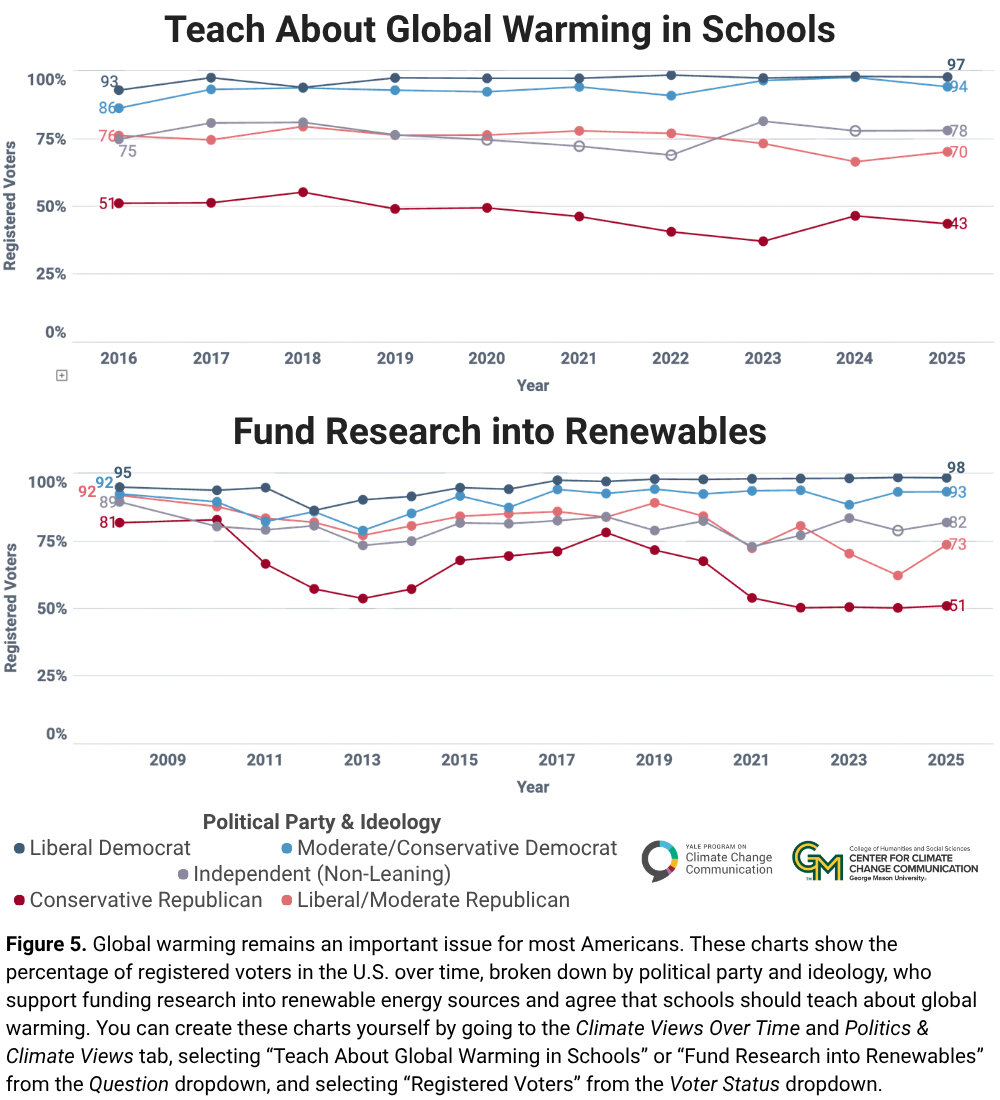
Despite its absence in the media, global warming remains an important issue for most Americans. More than three-quarters of registered voters support funding research into renewable energy (78%) and think schools should teach children about global warming (76%). Even among conservative and moderate Republicans, 51% and 73%, respectively, support funding research into renewable energy, and 43% and 70%, respectively, think schools should teach children about global warming.
These results demonstrate some of the many ways that people’s climate beliefs and risk perceptions are tied to their identities and political ideologies, providing different opportunities for targeted climate change communication.
Explore the CCAM Explorer by navigating the three tabs at the top of the tool — Climate Views by Demographics, Climate Views Over Time, and Politics and Climate Views — to view detailed data breakdowns. You can customize the data displayed on each tab by using the dropdown menus (e.g., select questions, time period, and baseline sample).