Climate Note · Aug 25, 2026
What do Global Warming’s Six Americas think about data centers?
By Neha Gour, Joshua Ettinger, Teresa Myers, Julia Fine, Jennifer Carman, Emily Goddard, John Kotcher, Edward Maibach, Seth Rosenthal and Anthony Leiserowitz
Filed under: Policy & Politics and Audiences
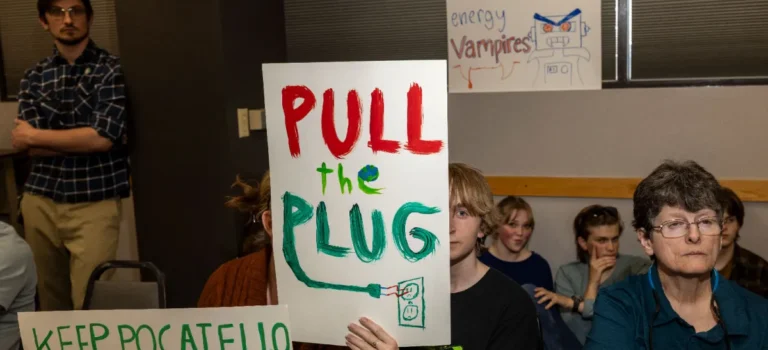
The number of data centers is rapidly increasing across the United States as investment in artificial intelligence grows. Although data centers can generate economic benefits, they also increase demand for electricity, water, and land, with potential public health implications. To address the electricity needs of data centers, some have proposed that developers, rather than building new power plants just for data centers, should instead install rooftop solar on and/or help weatherize and insulate nearby homes for homeowners who want it.
Public opinion plays an important role in shaping decisions about future data center development. In our latest Climate Change in the American Mind survey, conducted in Spring 2026, we asked Americans about their views on local data center development, whether they think new data centers will affect electricity bills, and whether they support requiring new data centers to offset their electricity use by installing rooftop solar on and/or weatherizing and insulating local homes. This analysis examines how public opinion about these questions differs across Global Warming’s Six Americas, our framework for understanding the spectrum of views on global warming.
Key takeaways
- Opposition to building data centers in local communities varies across Global Warming’s Six Americas, ranging from 71% The labels in the graph are rounded to the nearest whole number. among the Alarmed to 32% among the Disengaged.
- The Alarmed and the Concerned are the most likely to expect that new data centers will increase local electricity bills, while the Disengaged are the most likely to say they don’t know.
- The Alarmed and Concerned are the most supportive of requiring data centers to offset their electricity use by installing rooftop solar on and/or weatherizing and insulating local homes, while the Dismissive are the least supportive.
Results
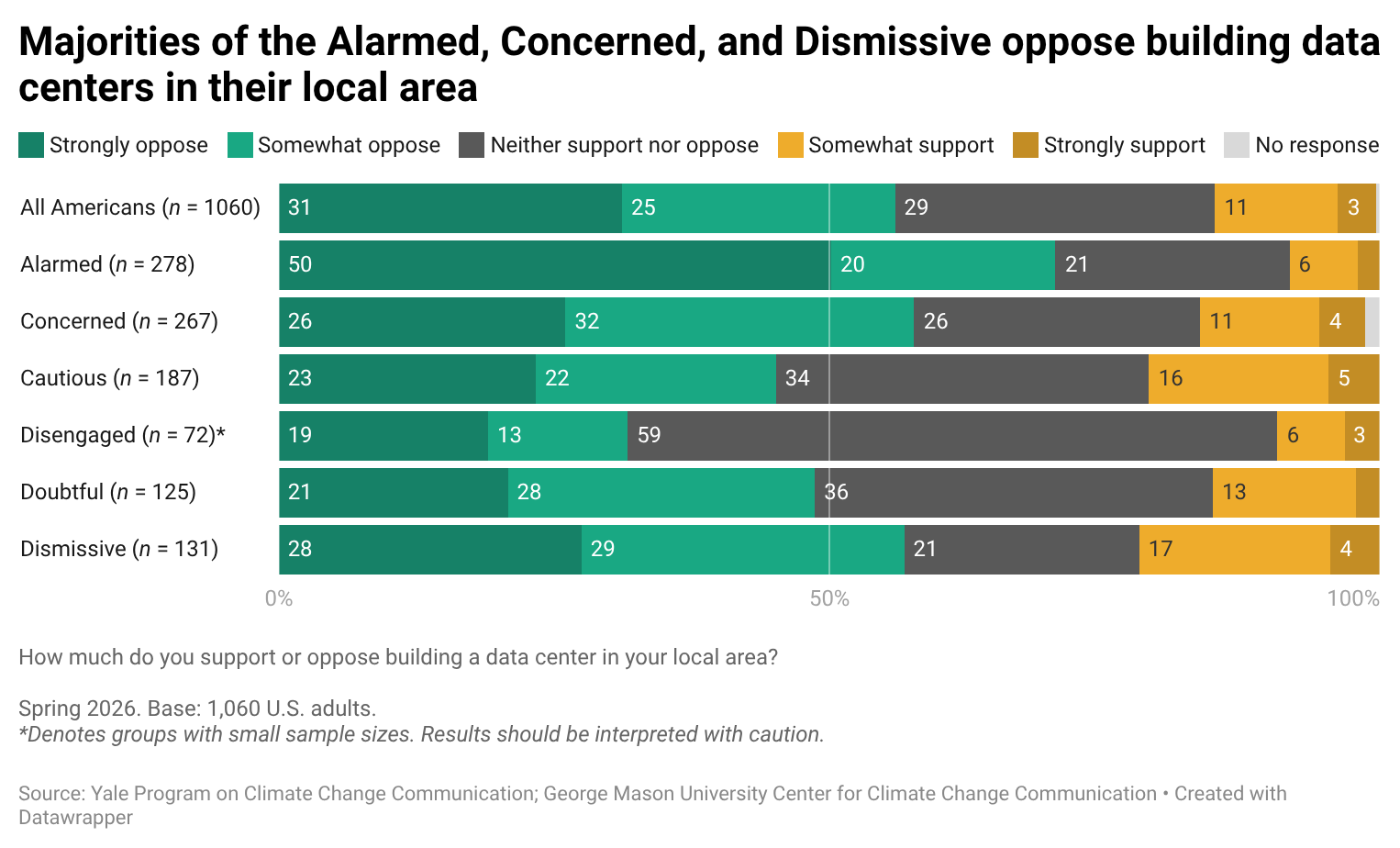
A majority of Americans (56%) “strongly” or “somewhat” oppose building a data center in their local area, while only 15% “strongly” or “somewhat” support building one. Opposition varies across Global Warming’s Six Americas, ranging from 71% among the Alarmed to 32% among the Disengaged Results for the Disengaged should be interpreted with caution due to small sample size.. Majorities of the Concerned (58%) and the Dismissive (57%) are opposed, while about half or less of the Doubtful (49%) and the Cautious (45%) oppose building a data center in their local area.
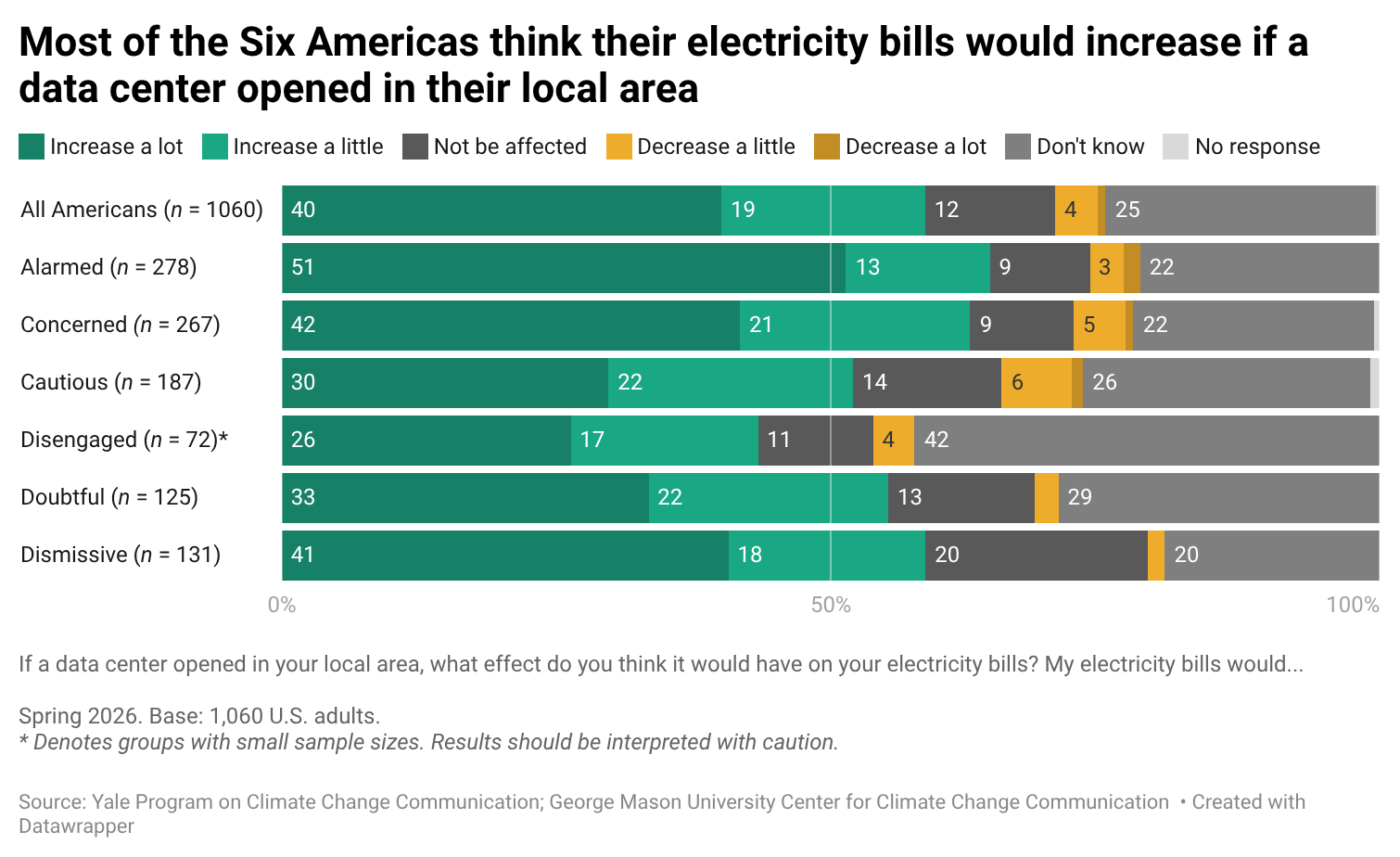
A majority of Americans (59%) also think their electricity bills would increase “a lot” or “a little” if a data center opened in their local area, while only 5% think they would decrease, and 25% don’t know. Expectations that electricity bills would increase vary across Global Warming’s Six Americas, ranging from 65% among the Alarmed to 43% among the Disengaged. Majorities of the Concerned (63%), Dismissive (59%), Doubtful (55%), and Cautious (52%) also think electricity bills would increase. The Disengaged are the most likely to say they don’t know (42%).
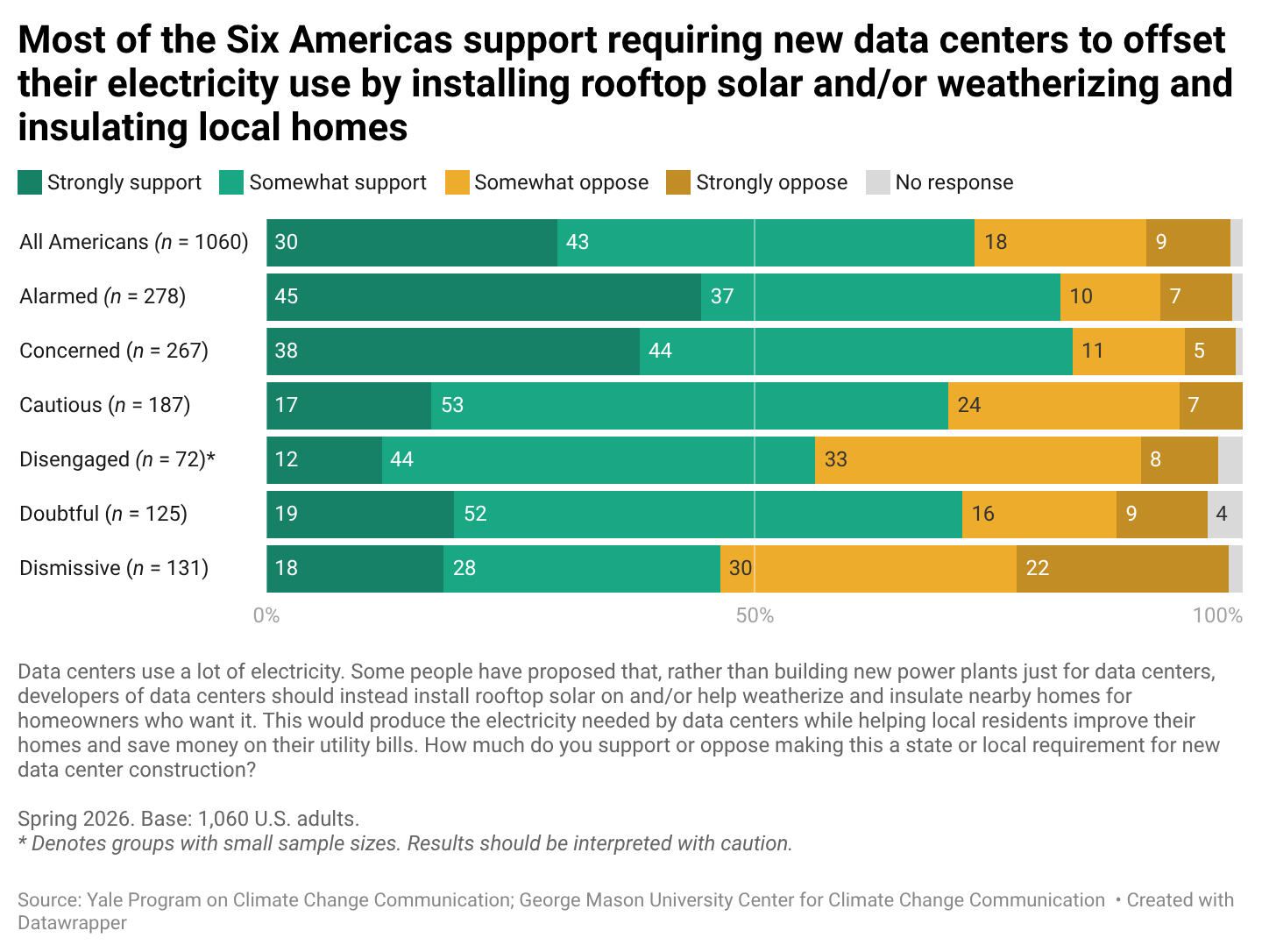
A large majority of Americans (73%) “strongly” or “somewhat” support a proposal requiring new data centers to offset their electricity use by installing rooftop solar on, and/or helping to weatherize and insulate nearby homes, while only 26% oppose it. Although support varies across Global Warming’s Six Americas, majorities of the Concerned (83%), Alarmed (81%), Doubtful (71%), Cautious (70%), and Disengaged (56%) all support the proposal. Support is lower among the Dismissive, but 47% still support the proposal while 52% oppose it.
Conclusion
Although the Six Americas have sharply divergent views on the issue of global warming, majorities of the Alarmed, Concerned, and Dismissive are all opposed to building data centers in their local area. Additionally, among the Cautious, Disengaged, and Doubtful, opposition outweighs support by a margin of at least 2 to 1. There is even greater agreement among the Six Americas about the effect of data centers on electricity prices. Majorities of all the segments, except for the Disengaged, think their electricity bills would increase if a new data center opened in their area. This demonstrates that people with widely different beliefs about global warming nonetheless currently have similar views about data centers.
Notably, the Disengaged were the most likely of the six segments to say they neither support nor oppose building a data center in their local area (59%) and that they don’t know what effect it would have on their electricity bills if a new data center opened in their local area (42%). This suggests that, like the issue of global warming, many of the Disengaged have not yet formed strong opinions about data centers. Although prior research suggests the Disengaged (7% of Americans) may be harder to reach because they are less likely to pay close attention to the news, there may be an opportunity to educate members of the Disengaged about the effects of data centers on electricity prices and public health, as well as their broader implications for global warming.
Majorities of the Alarmed, Concerned, Cautious, Disengaged, and Doubtful support requiring new data centers to offset their electricity use by installing rooftop solar on and/or helping to weatherize and insulate nearby homes. The Dismissive are the only segment where less than a majority support this proposal, although 47% still support it, suggesting that a substantial share of this group is willing to support local clean energy and energy efficiency upgrades in the context of this proposal.
The findings demonstrate the value of examining public opinion through the lens of Global Warming’s Six Americas. Understanding how different audiences perceive the benefits and trade-offs of data center development can help inform more targeted communication, community engagement, and policy discussions as data center expansion continues across the United States.
Methods
The results of this Climate Note are based on Spring 2026 data from the Climate Change in the American Mind survey (n = 1,060), a nationally representative survey of U.S. adults conducted by the Yale Program on Climate Change Communication and the George Mason University Center for Climate Change Communication. The survey was conducted April 17–26, 2026. Respondents were categorized into Global Warming’s Six Americas using the Yale Program on Climate Change Communication’s Six Americas Super Short Survey. Percentages are weighted to match national population parameters.
Participants were also asked the following questions:
“How much do you support or oppose building a data center in your local area?”
“If a data center opened in your local area, what effect do you think it would have on your electricity bills?”
“Data centers use a lot of electricity. Some people have proposed that, rather than building new power plants just for data centers, developers of data centers should instead install rooftop solar on and/or help weatherize and insulate nearby homes for homeowners who want it. This would produce the electricity needed by data centers while helping local residents improve their homes and save money on their utility bills. How much do you support or oppose making this a state or local requirement for new data center construction?”
Group differences were tested for statistical significance using survey-weighted Rao–Scott chi-square tests. Overall response distributions differed significantly across Global Warming’s Six Americas for all three questions (all p < .001). The average margin of error for the full sample is +/- 3 percentage points at the 95% confidence level.
The average margins of error at the 95% confidence level for the Six Americas subgroups, with unweighted sample sizes and percentages weighted to match key U.S. Census demographics, are:
- Alarmed: +/- 5.9 percentage points (n = 278, 27% of Americans)
- Concerned: +/- 6.0 percentage points (n = 267, 25% of Americans)
- Cautious: +/- 7.2 percentage points (n = 187, 18% of Americans)
- Disengaged: +/- 11.5 percentage points (n = 72, 7% of Americans)
- Doubtful: +/- 8.8 percentage points (n = 125, 11% of Americans)
- Dismissive: +/- 8.6 percentage points (n = 131, 12% of Americans)