Climate Note · Jul 7, 2026
Mental Images of Global Warming in the Indian Mind
By Jagadish Thaker, Marija Verner, Jennifer Carman, Seth Rosenthal, Mallika Talwar, Emily Goddard, Emily Richards, Jennifer Marlon, Gaura Shukla, Yashwant Deshmukh and Anthony Leiserowitz
Filed under: Beliefs & Attitudes, Messaging and Climate Impacts

Global warming is increasingly shaping daily life in India through extreme heat, changing rainfall patterns, floods, and droughts. But public understanding of “global warming” is not uniform. To better understand how people in India intuitively make sense of global warming, we asked 2,164 respondents randomly selected across India an open-ended question: “When I say ‘global warming,’ what is the first word or phrase that comes to your mind?”
We transliterated ‘global warming’ into multiple Indian languages, following similar usage by the national and state governments, vernacular press, and civil society organizations. Although there are other local translations of the term, such as ‘Jal vayu parivartan’ in Hindi, such terms have yet to become a popular, pan-Indian term, largely due to India’s immense linguistic diversity.
The questions were asked over phone in 12 Indian languages, including English, and responses were coded verbatim and then translated into English for analysis. Survey participants provided either single word associations (e.g., “pollution”) or short narrative statements (e.g., “destruction of life on earth”). These responses were coded using categories from previous studies on affective reactions (e.g., Leiserowitz, 2006), including from India (Thaker, Smith, & Leiserowitz, 2020). The categories were not mutually exclusive: for example, the response “polluted environment” was coded both for “pollution” and “nature.”
It is also important to note that a lack of familiarity with the term does not mean people in India are not experiencing changes in local weather patterns or worry about climate-related environmental hazards, as evidenced in our previous surveys conducted between 2011-2025.
Key associations with global warming
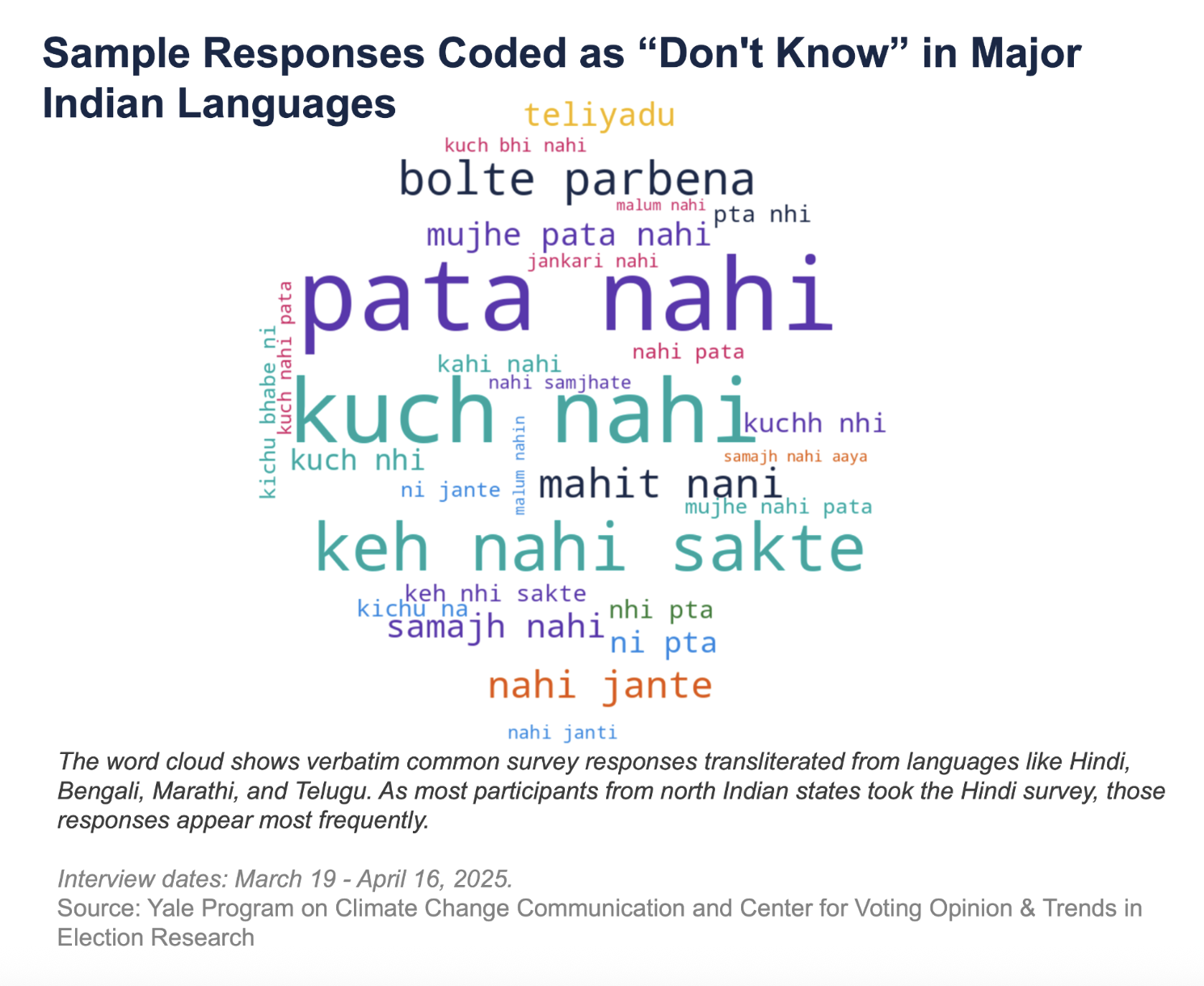
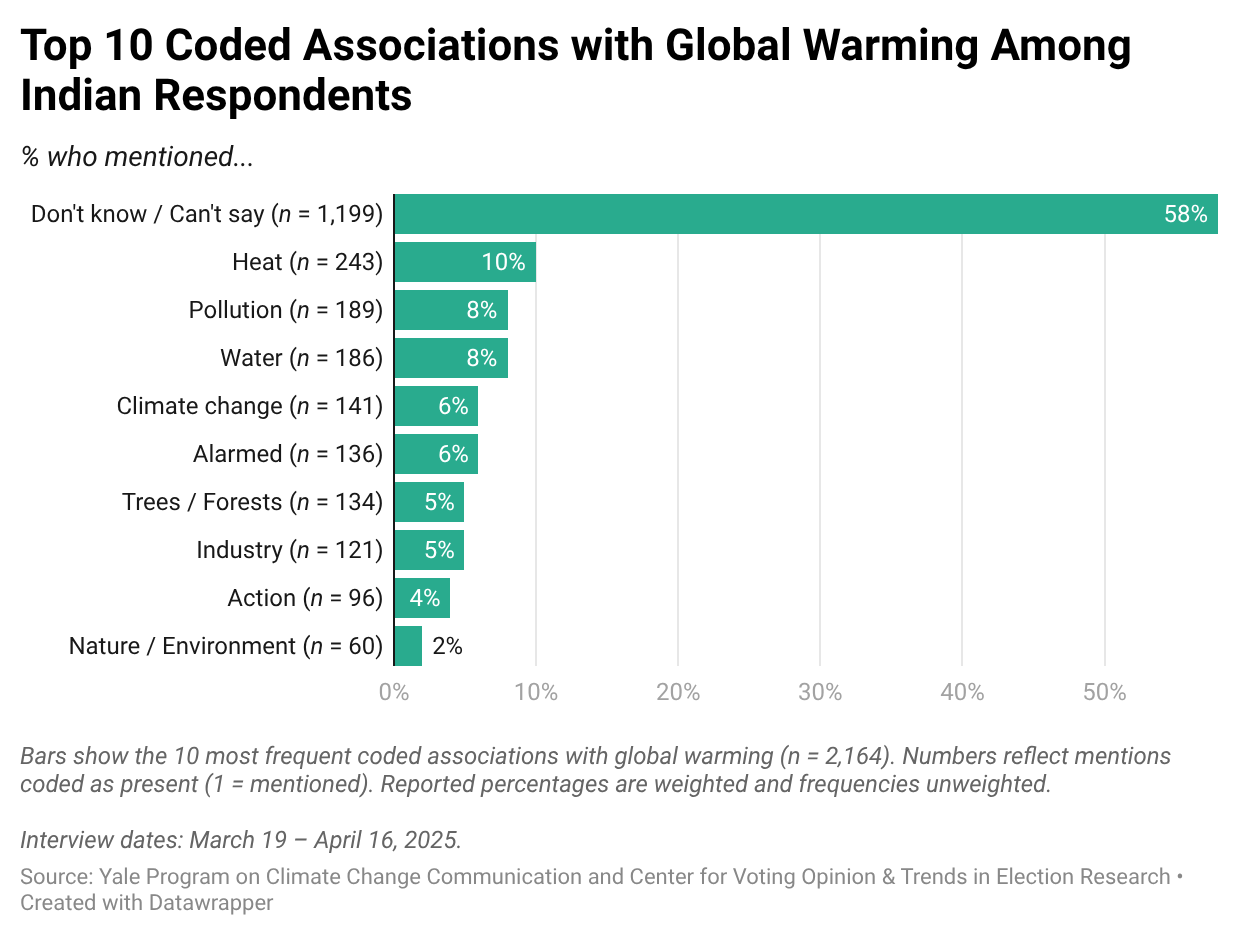
Over half of the respondents (58%) said that they did not know or could not say anything specific when asked about the first word or phrase that comes to mind when they hear “global warming.”Only 6 out of 2,164 respondents did not provide any response and were consolidated within this category of “Don’t know” for analysis. All other responses were coded in one of the categories listed below or coded into a new category.The full list of categories include: Don’t know or Can’t say, Action, Climate change, Alarmed, Heat, Weather changes, Changing temperature, Water, Pollution, Global, Ozone, Nature/Environment, Trees/Forests, Industry, Heath, Snow/Glacier, Earthquake, and Population. These findings are also consistent with our survey finding that 44% of people in India say they know “just a little” (17%) about global warming or that they have “never heard of it” (27%).
Associations other than “Don’t know” were most often made to Heat (10%), Water (8%), and Pollution (8%). Other notable categories included Climate Change (6%) and Alarmed (6%), which refers to projections of catastrophic impacts for the present and future generations, such as “nature is getting destroyed.”
Few respondents mentioned Trees or Forests (5%), Industry (5%), and Action (4%). Fewer mentioned Nature/Environment (2%), Changing Temperature (2%), Snow/Glacier (1%), and Weather Changes (1%). References to Ozone (hole), Health, Earthquakes, and Global each represented less than 1% of the total responses.
These findings indicate that for a majority of people in India, global warming remains an unfamiliar term. But among the minority who are familiar with the term, Heat, Water, and Pollution are the most common associations.
Differences by gender and age
There was no major difference between men and women on several types of associations. For example, 58% of men and women said they don’t know in response to the question. However, women were more likely to mention Heat (12%) than men (9%). Conversely, men (7%) were more likely to provide Alarmed associations, such as “destruction of the planet”, compared to women (5%).
We also examined differences among age groups (18-24; 25-34; 35-44; 45-54; 55-64; 65 years and above). More than half of younger respondents (ages 18–24) said they don’t know (59%), while among the 45–54 age group, only 50% did so. Mentions of Water also varied significantly by age, peaking among those aged 45–54 years (12%).
Younger respondents (10%) were more likely to mention Pollution than others. Conversely, mentions of Climate Change showed a steady increase with age.
Differences by education and income
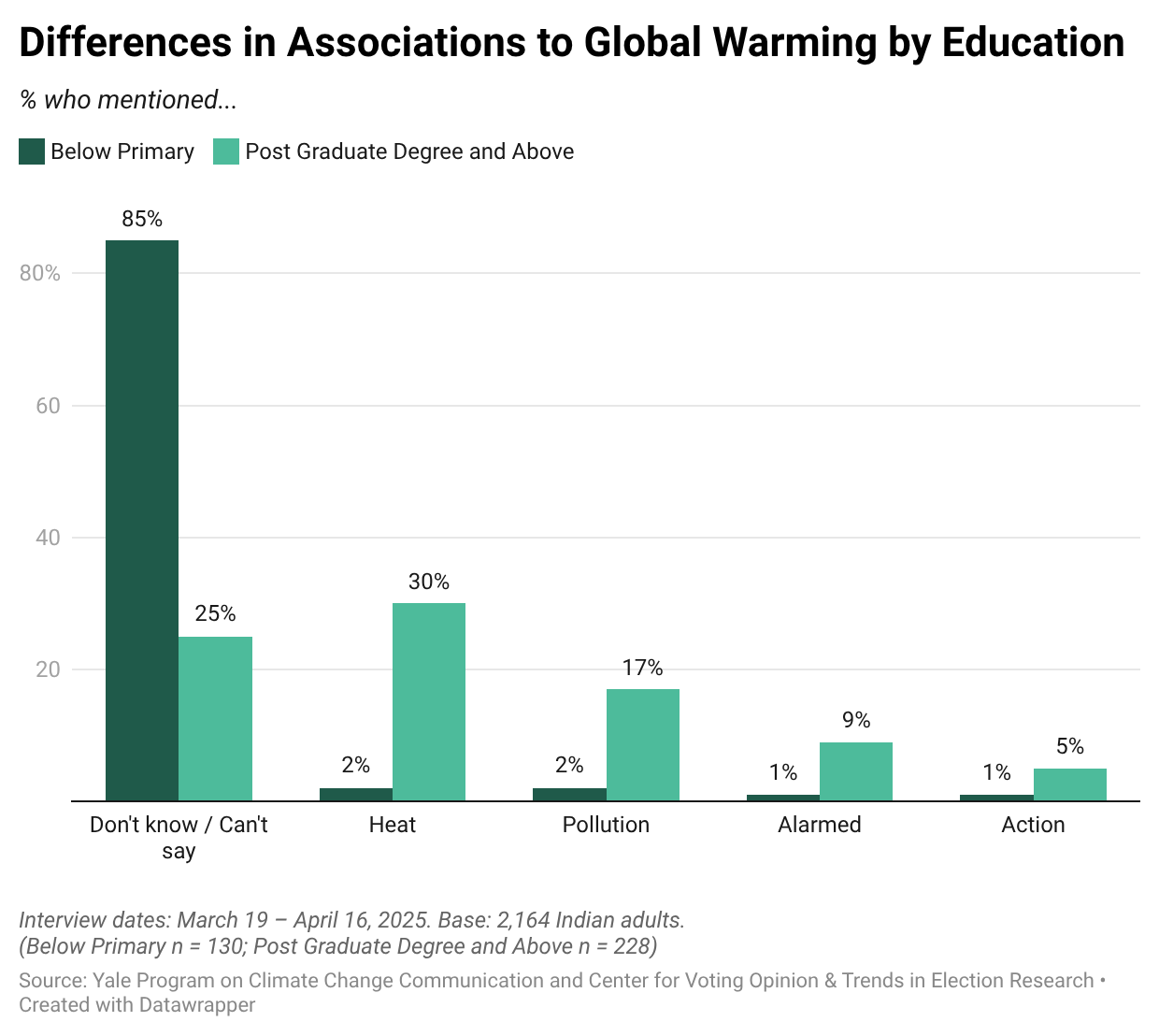
EducationEducation was measured by asking respondents the level they have studied using 10 categories, including Not literate; Literate without formal schooling; Literate but below primary; Primary; Middle; Secondary; Higher secondary; Diploma/certificate course; Graduate; Post graduate and above. For ease of interpretation, we re-coded these into six categories (Below Primary; Up to Secondary; Secondary; Higher Secondary or Diploma/Certificate course; Graduate; Post graduate and above). was the strongest demographic predictor of differences in the associations people in India have with the term global warming. Among those with low education (Below primary), 85% provided a Don’t know response, compared to only 25% with a Postgraduate degree or above. Higher education levels were also strongly correlated with the categories of Heat, Water, Climate Change, Pollution, and Alarmed. For example, 29% of those with a Postgraduate degree or above referenced Heat while only 2% said so among those with low educational attainment (Below primary).
In the lowest income bracket (< Rs 3,000 average monthly family income), 69% said they did not know, compared to 34% in the highest bracket (> Rs 1,00,000). Higher income was also significantly correlated with mentioning Heat and Water.
Differences by religion, caste, and location
Non-Hindu respondents were more likely to say they don’t know (64%) compared to Hindu respondents (57%). Conversely, Hindu respondents (6%) were more likely to express Alarm than non-Hindu respondents (4%).
Among caste groups, Scheduled Tribe (ST) respondents were most likely to say they don’t know about global warming (67%) compared to others (58%). Scheduled Caste (SC) respondents were significantly more likely to mention Water (11%) than non-SC respondents (8%).
Those who said they voted for Bharatiya Janata Party (BJP, the current government led by Prime Minister Modi) in the previous election were significantly more likely to say Don’t know (61%) compared to others (56%). However, our previous research shows that the audience segments who are Alarmed or Concerned about climate change are more likely to have voted for BJP (Leiserowitz et al., 2023).
Rural residents were more likely to say Don’t know (65%) compared to urban residents (48%). Urban residents were also more likely to associate global warming with Heat (13%) compared to rural residents (9%). Semi-urban respondents (14%) were more likely to refer to Water compared with rural (7%) and urban (9%) respondents.
Overall, these findings show that a majority of Indians are still largely unaware of the term “global warming,” even 15 years after we first conducted a national survey in 2011. Heat, Water, Pollution, Climate Change, and Alarmed are some of the words that are closely associated with global warming among the minority of Indians who are more familiar with the term.
Methods
This report is based on findings from a nationally representative survey of adults (18+) in India conducted by the Yale Program on Climate Change Communication and CVoter, an international survey company headquartered in Delhi, India. A nationally representative sample of respondents was contacted by mobile telephone using predictive dialing technology and computer-assisted telephone interviewing (CATI). The survey was administered in 12 Indian languages (Asamiya, Bangla, English, Gujarati, Hindi, Kannada, Malayalam, Marathi, Odiya, Punjabi, Tamil, and Telugu) and respondents received the survey in one of those languages based on their geographic location in India. National Census-based demographic parameters were used to create sampling targets for gender, education, and socioeconomic status. The results were also weighed after completion of the data collection period to adjust the final sample to match national demographic parameters on gender, age, education, income, religion, and urbanicity. Interview dates: March 19 – April 16, 2025. Interviews: 2,164 adults (18+). Average margin of error: +/- 2.1 percentage points at the 95% confidence level.
For tabulation purposes, percentage points in the text and figures are rounded to the nearest whole number.
View Data Tables for accessibility