Peer-Reviewed Article · May 7, 2026
Communicating the impact of climate change on extreme weather in India, the United Kingdom, and the United States
By Laura Thomas-Walters, Matthew Goldberg, Eric Scheuch, Sanguk Lee, Jagadish Thaker, Aidan Lyde, Seth Rosenthal and Anthony Leiserowitz
Filed under: Climate Impacts and Messaging

We are pleased to announce the publication of a new article, “Communicating the impact of climate change on extreme weather in India, the United Kingdom, and the United States” in the journal Global Environmental Psychology.
Extreme weather is one of the most harmful impacts of climate change, posing a risk to human health and well-being worldwide. However, the types and impacts of extreme weather vary widely across countries. In some countries, for example, flooding is a primary risk, while others are more vulnerable to extreme heat. To understand how to communicate about the links between climate change and extreme weather, we conducted a message experiment with over 10,000 respondents across India, the UK, and the US.
Building on our previous research in the US, we tested simple messages using Climate Central’s Climate Shift Index (CSI), which calculates how much more likely climate change made an extreme weather event. We tested the effects of the same information expressed in two different ways: in terms of magnitude (“climate change made heat waves three times more likely”) or in equivalent terms of percentage (“climate change made heat waves 200% more likely”). We also tested both of these statistical frames for flooding as well as heat waves. All treatment messages were compared to a pure control message (i.e., a message on an unrelated topic) as well as an active control message describing extreme weather events without attributing them to climate change. An example treatment message displayed to participants is shown below.

We found that all of our messages significantly increased people’s understanding that climate change is making extreme weather more likely. The figure below displays all effect sizes, both for the full sample and broken out by country. Effect sizes are shown as standardized mean differences. To give a more intuitive sense of these effect sizes, the messages increased the percentage of respondents who believe climate change made extreme weather more likely by 4.5 to 6.1 percentage points.
It is important to note that, as the below figure shows, effects were larger in the UK and the US than in India. Although there are many potential explanations for differences in effects across countries, we found that Indian participants had a much higher baseline belief (i.e., before receiving any message) that climate change is making extreme weather more likely, limiting the potential size of the message effects in India.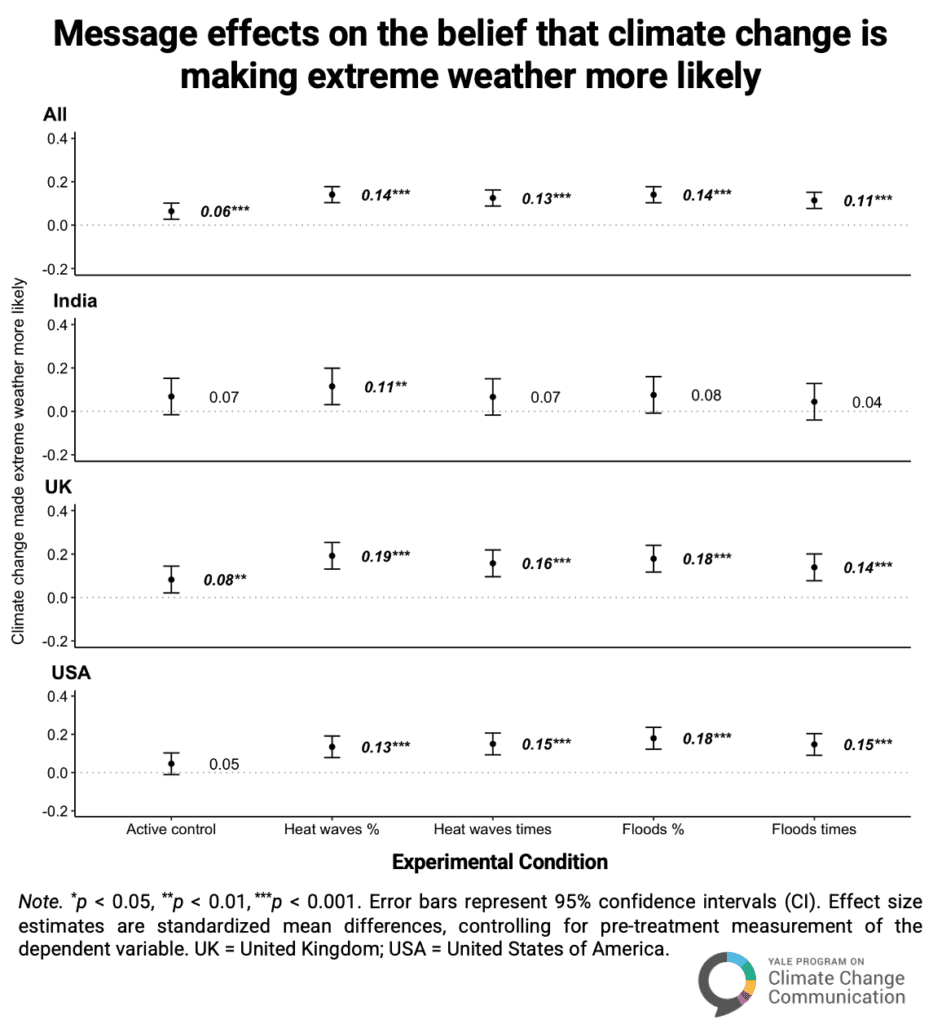
We found no significant differences between messages that mentioned heat waves versus messages that mentioned floods: both kinds of messages were similarly effective. Further, and contrary to our findings in a prior study, we found no difference in message effects depending on whether the message was framed as “200% more likely” or “3 times more likely” (numerically equivalent statements).
Overall, these findings indicate that there are multiple routes to build people’s understanding that climate change is making extreme weather more likely, and that these messages are effective across a wide range of audiences.
The full paper includes many other important results, including the impact of the messages on the understanding that climate change made extreme weather worse, support for government action, and a wide range of subgroup analyses. The full open-access article with many other results is available here at the journal Global Environmental Psychology.