Climate Note · Aug 28, 2025
Public Opinion on Climate Attribution: Majorities of Americans think global warming is affecting extreme weather events
By Jennifer Marlon, Emily Goddard, Martial Jefferson, Seth Rosenthal, Jennifer Carman, Emily Richards, Andrew Gillreath-Brown and Anthony Leiserowitz
Filed under: Beliefs & Attitudes and Climate Impacts
We are excited to release new maps of Americans’ climate attribution beliefs in the Yale Climate Opinion Maps (YCOM) interactive tool, as well as the corresponding Yale Climate Opinion Factsheets tool.
Key Findings:
- Majorities of Americans think global warming is affecting extreme heat (64%), wildfires (63%), drought (61%), flooding (58%), hurricanes (58%), and rising sea levels (58%).
- Public beliefs lag scientific assessments of the effects of global warming on extreme heat and rising sea levels.
- Americans are more likely to attribute temperature-related changes in weather (extreme heat, wildfires, drought) than moisture-related changes (sea level rise, hurricanes, and flooding) to global warming.
The maps show that majorities of Americans think global warming is affecting extreme heat (64%), wildfires (63%), droughts (61%), flooding (58%), hurricanes (58%), and rising sea levels (58%). However, they also show that levels of public understanding about climate change attribution differ across the country. (Fig. 1).
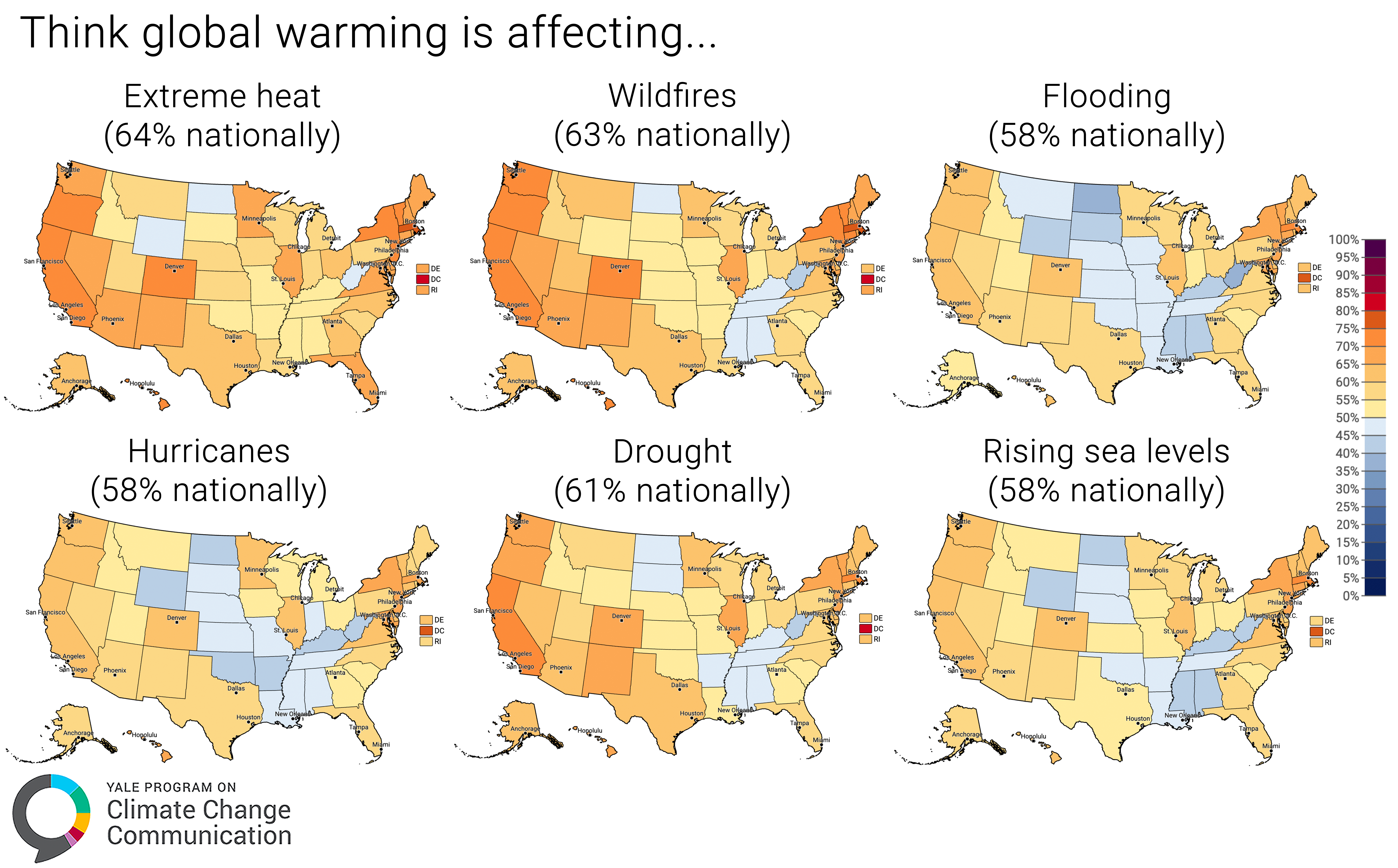
Figure 1. The belief that global warming is affecting extreme weather events varies across geography and extreme weather events. [Explore the maps]
Climate Change Attribution Science
Weather and climate are different but interrelated (see here for a discussion about the terms climate change vs. global warming). Weather is what happens day-to-day, while climate is the long-term average of weather conditions over several decades or more. Extreme weather event attribution is the science that determines how much human-caused climate change affects specific weather events, such as the recent Texas and Kentucky floods and the summer heat dome in the eastern and midwestern U.S. Carbon pollution accumulating in the atmosphere traps more heat and warms the planet. This warming affects temperature-related events like heat waves, droughts, and wildfires. It also influences precipitation events by increasing the amount of water in the atmosphere, altering rainfall patterns, and intensifying storms and flooding events.
Scientists combine historical records, physics, and climate models to analyze the multiple factors that influence extreme weather to determine how much global warming contributed to specific events. Differences in data availability, scientific understanding, and the complexity of different events make conclusions about some types of events more certain than others. The effect of human activities on extreme temperatures, for example, whether hot or cold, can often be identified with high scientific confidence. Some extreme rainfall events, droughts, and floods can also be linked to global warming due to the relationship between temperature and atmospheric moisture.
Extreme event attribution for compound events, like wildfires and hurricanes, is more complex. Extreme wildfires, for example, occur in hot, dry, and windy conditions when abundant, dry vegetation is available to burn. Teasing apart the relative influences of these multiple meteorological and environmental factors for a particular event is challenging. For example, decades of aggressive fire suppression have led to a buildup of vegetation (and thus fuels) nationwide, and many fires are started by humans, whether accidentally or purposely. Nevertheless, there is strong evidence that climate change is affecting entire classes or types of events (e.g., all heat waves, or all wildfires), even if individual events can’t be analyzed in detail. For example, there is abundant evidence that wildfires as a whole are growing larger and more uncontrollable due to hotter spring, summer, and fall temperatures, increased drought, and increased lightning—factors directly resulting from human-caused climate change. Likewise, even though extreme weather event attribution science often cannot say whether a particular hurricane was directly caused by climate change, scientists have determined that the rainfall and flooding during Hurricane Helene, Hurricane Harvey, Superstorm Sandy, and Hurricane Maria were worsened by climate change.
How well do Americans’ beliefs align with the science behind extreme event attribution?
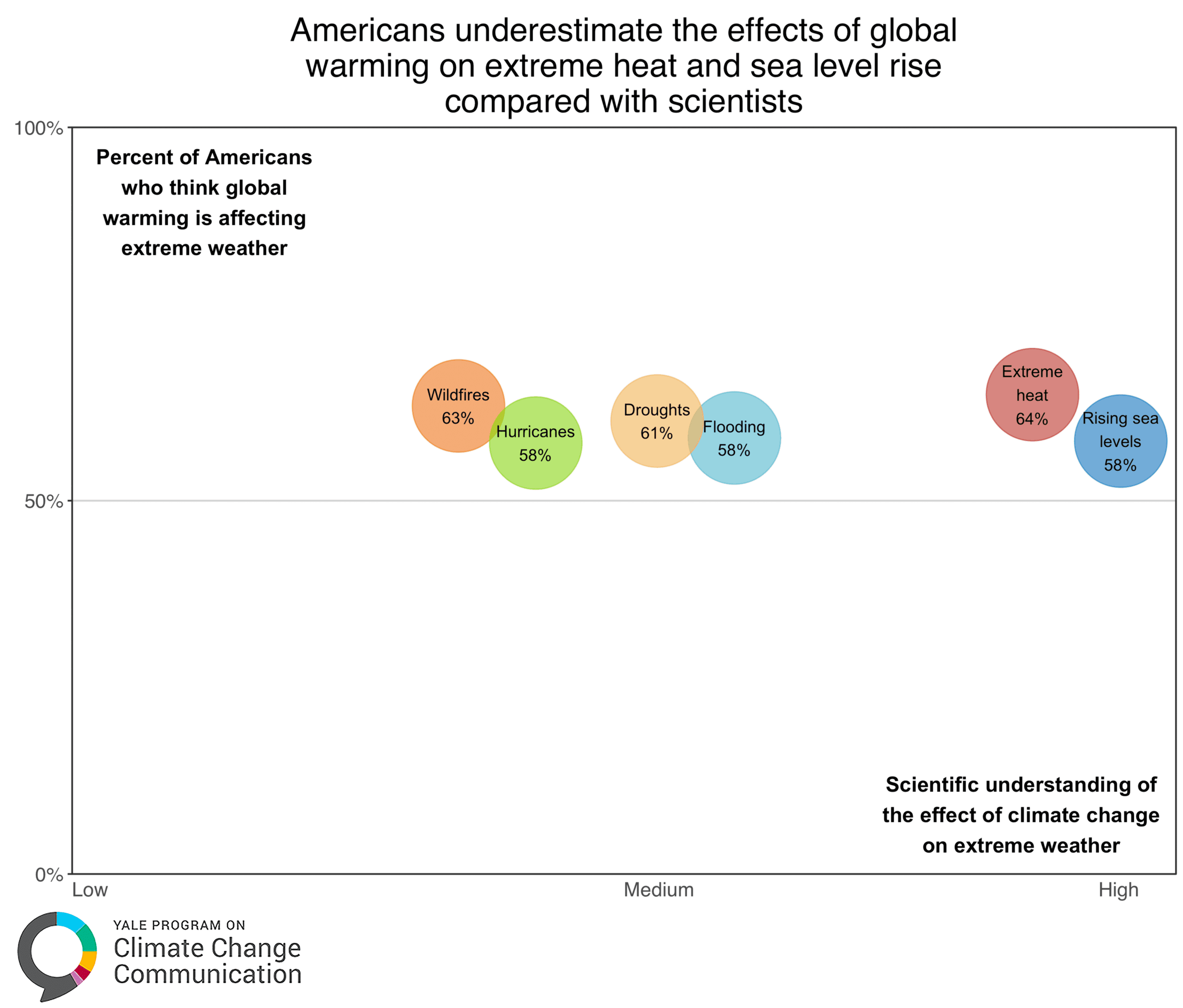
Figure 2. Relationship between Americans’ beliefs and scientific assessments that climate change is affecting extreme weather. Scientific certainty about the attribution of extreme weather events to climate change is advancing rapidly. We draw on the National Academy of Sciences, Engineering, and Medicine report, “Attribution of Extreme Weather Events in the Context of Climate Change,” and two peer reviewed publications: “Extreme weather impacts of climate change: an attribution perspective” by Clarke et al. (2022), and “Comparing public and scientific extreme event attribution to climate change” by Zanoco et al. (2020) to approximate the levels of scientific certainty about six event types. These studies use differing language to refer to extreme weather events. We approximate understanding of flooding, which is an extreme event impact rather than an event itself, with that of extreme rainfall, which is the root cause of flooding. Likewise, we approximate understanding of hurricanes, as asked in our survey, with that of tropical and extra-tropical cyclones. [Explore the maps]
Many Americans do not understand that global warming is affecting extreme weather events, particularly extreme heat and sea level rise (Fig. 2). For example, despite the strong evidence and high certainty among climate scientists [1] [2] [3] [4] that global warming is causing more frequent and severe heat waves, only 64% of U.S. adults nationally understand this, even though 72% believe that global warming is happening (Fig. 3).
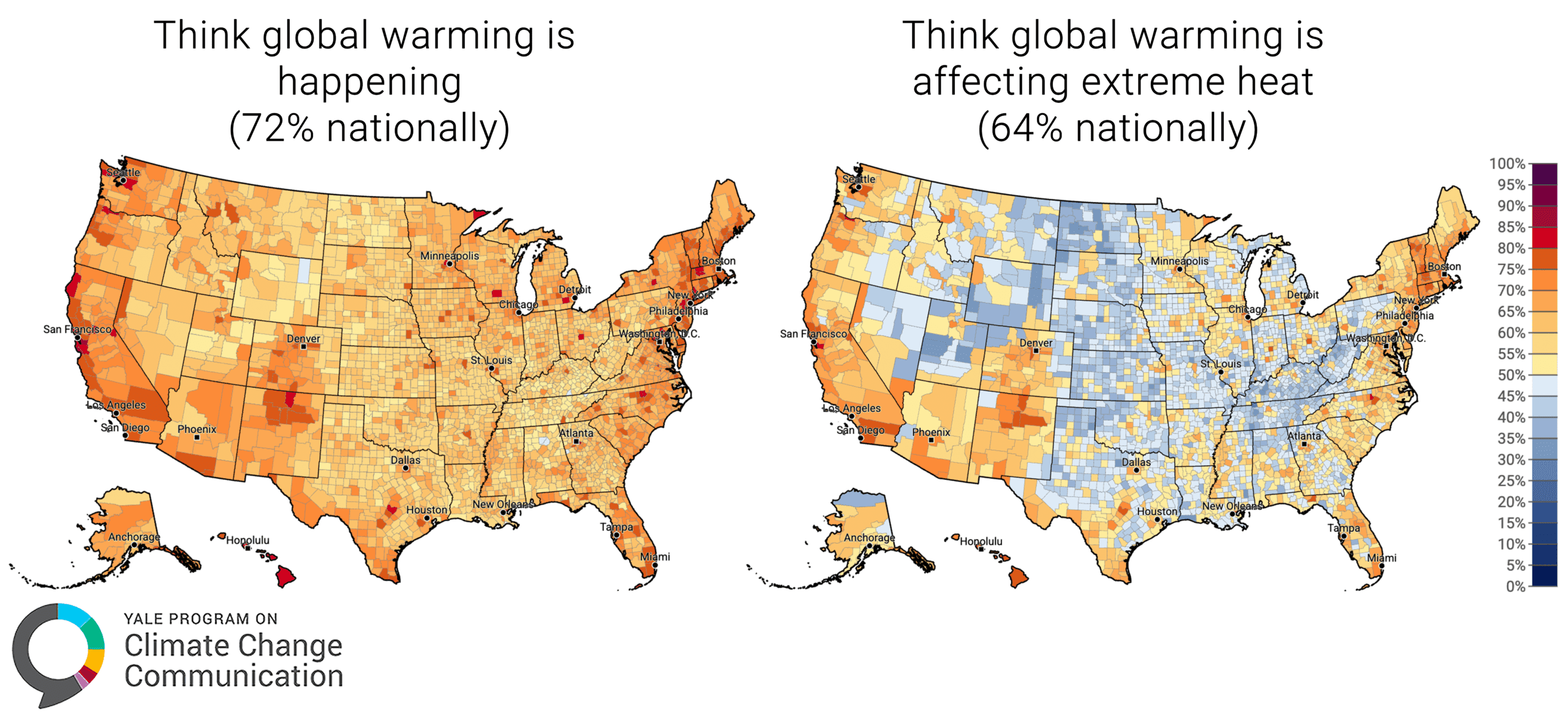
Figure 3. Spatial patterns show a similar trend to other climate opinions, suggesting that beliefs about climate change attribution are related to beliefs about climate change. [Explore the maps].
Beliefs about the influence of global warming on other extreme weather events are 63% for wildfires, 61% for drought, and 58% for flooding and hurricanes (Fig. 1). Judgments about extreme weather appear better explained by pre-existing ideologies and beliefs about climate change than by the attribution science linking human-caused warming to extreme events. For example, it is an uncontested scientific fact that sea levels are rising due to global warming—water expands when it warms, and glacier melt increases sea levels. Yet, only 58% of Americans currently understand this.
Extreme weather events will continue to worsen as the world continues to emit carbon pollution. However, these events also offer opportunities to educate the public about the cause-and-effect relationship between burning fossil fuels and dangerous weather.
We hope that these maps will be helpful in supporting more communication about the threats posed by climate change in the U.S. and beyond. Explore the maps on our website by clicking and zooming into your state, congressional district, metro area, or county.
Methods
The modeling employs data from 31 nationally representative surveys of American adults (18+) conducted from November 2008 through December 2024 with a combined sample size of n>35,000. The surveys were administered by Ipsos and drawn from the Ipsos KnowledgePanel®, an online panel of members drawn using probability sampling methods. All questionnaires were self-administered by respondents in a web-based environment, and computers were loaned to individuals who were chosen to participate but did not have access. Respondents came from all 50 states and the District of Columbia, and 2,379 of 3,144 counties. Sample weights for all respondents were calculated by Ipsos to be nationally representative post-survey to match U.S. Census Bureau norms. For respondents who have taken the survey multiple times, only their most recent response was kept in the data, and all previous responses were removed. This resulted in 3,108 responses being removed.
Multilevel modeling with poststratification (MrP) was used to estimate the spatial distribution of climate opinions at state, county, congressional district, and metro area levels (Howe et al. 2015; Mildenberger et al. 2016, 2017). Dependent variables were first recoded into binary format, with positive response values grouped and coded as “1” (e.g., “Somewhat favor” and “Strongly favor”) and non-positive values coded as “0” (“Somewhat oppose,” “Strongly oppose,” “Don’t know,” Refused); see “Survey Question Wording” on the interactive map tool tab for a full list of questions and how each was recoded to binary). MrP modeling then proceeded in two phases. First, the multi-level model was constructed by predicting individual survey responses as a function of both individual-level demographics (gender, race, education, and a three-way interaction term among these variables) and geography-level covariates. Second, “post-stratification,” or spatial weighting, was performed using the fitted model, where population-weighted opinion estimates for each demographic-geographic subtype were aggregated based on the subtype population distribution within each geographic subunit.
The YCOM model uses four geography-level covariates: percent of people who drive alone to work, percent of same-sex households, percent of CO2 emissions per capita, and percent of people who voted Democrat in the most recent election. In order to ensure accurate and current estimates, two of the data sources used for these covariates in the current YCOM model (version 8) were updated to reflect more current data.
The U.S. Census Bureau’s American Community Survey (ACS) variable, which was previously the source of same-sex household data, was discontinued in 2018. Therefore, we replaced this covariate with the ACS variable “Coupled Households by Type,” which includes an almost identical survey question most recently asked in 2020. CO2 data from the Vulcan Project, originally published in 2010, were replaced with updated 2024 estimates of CO2 emissions from the same source and supplemented with new data from Crosswalk Labs, which provides estimates of CO2 emissions at the census tract level. Presidential vote share was acquired from the Redistricting Hub for the 2020 election, as the vote share data for 2024 is not yet available. All new sources of data were compared with their outdated counterparts and found to be highly correlated.
Validating models is essential for producing accurate results. Our original YCOM model estimates were validated using three different methods. First, cross-validation analyses were conducted within the dataset. The dataset was divided into two sets of respondents, with one part used to run the model and the other kept aside for validation. The model estimates were then compared to the results of the set-aside respondents to directly quantify the percentage of correct answers the model predicted. These cross-validation tests were repeated multiple times using different sample sizes and dividing the data in different ways. Second, the model estimates derived from the full dataset were compared to the results of independent, representative state- and city-level surveys conducted in California, Colorado, Ohio, Texas, San Francisco, and Columbus, Ohio in 2013. The mean absolute difference between model estimates and validation survey results was 2.9 percentage points (SD = 1.5) among the four states (CA, TX, OH, CO) and 3.6 percentage points (SD = 2.9) among the two metropolitan areas (Columbus, OH, and San Francisco, CA), well within the margins of error for the survey results alone (at a 95% confidence level). Estimates have also been validated internally through a series of technical simulations. Third, some model estimates were compared with third-party survey data collected by other researchers in previous years.
Our current model estimates were re-validated by comparing modeled estimates with weighted survey averages at the national level and for the five most populous states. The mean absolute error between modeled estimates and weighted survey averages across all variables was 0.51 percentage points at the national level and 3.63 percentage points at the state level.
For the 2024 model estimates, uncertainty ranges are based on 95% confidence intervals using 99 bootstrap simulations. These confidence intervals indicate that the model is accurate to approximately ±7 percentage points at the state and congressional district levels, and ±8 percentage points at the metro and county levels. Such error ranges include the error inherent in the original national surveys themselves, which is typically ±3 percentage points.
Trends over time from 2010–2020 are provided for 16 state-level climate opinions using data from Marlon et al. (2022). Estimates for 2021, 2022, 2023, and 2024 are generated using our conventional MrP model described in Howe et al. (2015).
NOTE: The Congressional District Maps reflect the 118th Congress (Jan. 2023 – Jan. 2025). Not all congressional districts have data due to litigation regarding the adoption of new redistricting plans. In 13 states where districts were in litigation at the time of census data collection, we are delaying the release of estimates. In all cases, keep in mind that the margin of error increases as you go to finer geographic scales (i.e., from state to county levels). Thus, it is not possible to know whether a county estimate of 42% is statistically different than an estimate in a nearby county of, say, 44%. You can also click each shade of color on the legend to highlight just the locations matching that value.